
AI vibe coding lets non-technical founders and agile teams build functional software prototypes faster than ever before. But once an app goes live, a new challenge emerges: software maintenance.
Up to 80% of a software application's lifecycle cost is spent on maintenance, not initial development. In vibe-coded applications, maintenance can quickly become nightmarish because AI-generated codebases frequently lack strict typing, comprehensive test suites, modular structure, and clear documentation.
If you find that every new prompt breaks an existing feature or dependency updates crash your build, this guide is for you. Here is your actionable playbook for maintaining a vibe-coded app for long-term health and stability.
The 4 Main Maintenance Pitfalls in Vibe-Coded Apps
- Hallucinated & Outdated Dependencies: AI tools often import obscure NPM/PyPI packages or deprecated library methods that stop working when frameworks update.
- Implicit & Broken Type Contracts: Usage of
any,unknown, or loose JSON payloads that crash silently at runtime when API data structures change. - Zero Test Safety Net: Without automated tests, every prompt update is a roll of the dice in production.
- Duplicate Code Bloat: AI assistants often rewrite helper functions instead of reusing existing utilities, resulting in multiple inconsistent implementations across the codebase.
The Vibe Code Maintenance Playbook
1. Enforce Strict Type Safety & Runtime Validation
The fastest way to prevent production crashes in an AI codebase is enforcing end-to-end type safety with TypeScript and Zod schema validation.
Never trust external API or database responses implicitly. Validate inputs and outputs at the boundary:
import { z } from "zod";

// Define strict schema for API payloads
export const UserProfileSchema = z.object({
  id: z.string().uuid(),
  email: z.string().email(),
  role: z.enum(["admin", "user", "guest"]),
  metadata: z.object({
    onboarded: z.boolean().default(false),
  }),
});

export type UserProfile = z.infer<typeof UserProfileSchema>;

// Validate incoming request data safely
export function parseUserProfile(input: unknown): UserProfile {
  const result = UserProfileSchema.safeParse(input);
  if (!result.success) {
    throw new Error(`Invalid user payload: ${result.error.message}`);
  }
  return result.data;
}
2. Build an Automated Testing Safety Net
You don't need 100% test coverage on day one. Focus on critical business workflows:
- Integration Tests (Vitest / Jest): Test key API endpoints, payment calculations, and authentication utility functions.
- End-to-End Tests (Playwright / Cypress): Automate core user journeys (Sign up -> Onboarding -> Checkout -> Dashboard load).
Having just 5 to 10 automated E2E tests running in CI/CD will catch 90% of regressions introduced by AI code generators before they reach production.
3. Establish a Weekly Code Hygiene & Refactoring Sprint
Set aside time every week for maintenance housekeeping:
- Prune Dead Code: Delete unused UI components, abandoned API routes, and commented-out AI scratchpads.
- Deduplicate Utilities: Consolidate duplicate helper functions into centralized
@/lib/utilsmodules. - Lock Dependency Versions: Use explicit versions in
package.jsonand commit yourpnpm-lock.yamlorpackage-lock.json.
4. Implement CI/CD Gatekeepers
Prevent buggy code from being pushed to main branches by setting up automated GitHub Actions or Vercel checks:
# Sample GitHub Actions CI Pipeline for Vibe Coded Repos
name: Code Quality Check
on: [push, pull_request]

jobs:
  verify:
    runs-on: ubuntu-latest
    steps:
      - uses: actions/checkout@v4
      - uses: actions/setup-node@v4
        with:
          node-version: 20
      - run: pnpm install
      - run: pnpm lint
      - run: pnpm tsc --noEmit
      - run: pnpm test
      - run: pnpm build
Maintenance Checklist for Vibe-Coded Apps
| Maintenance Layer | Action Item | Frequency |
|---|---|---|
| Dependencies | Run npm audit & update core security patches | Bi-weekly |
| Type Safety | Eliminate any types & enforce Zod boundary validation | Ongoing |
| Testing | Execute Playwright E2E suites on critical conversion flows | Every PR |
| Error Logs | Review Sentry exception rates and resolve top 3 recurring bugs | Weekly |
| Database | Review slow query logs and clear stale session records | Monthly |
How Vidyayatan Simplifies App Maintenance & Retainers
Maintaining an application shouldn't take your focus away from product strategy, customer acquisition, and fundraising.
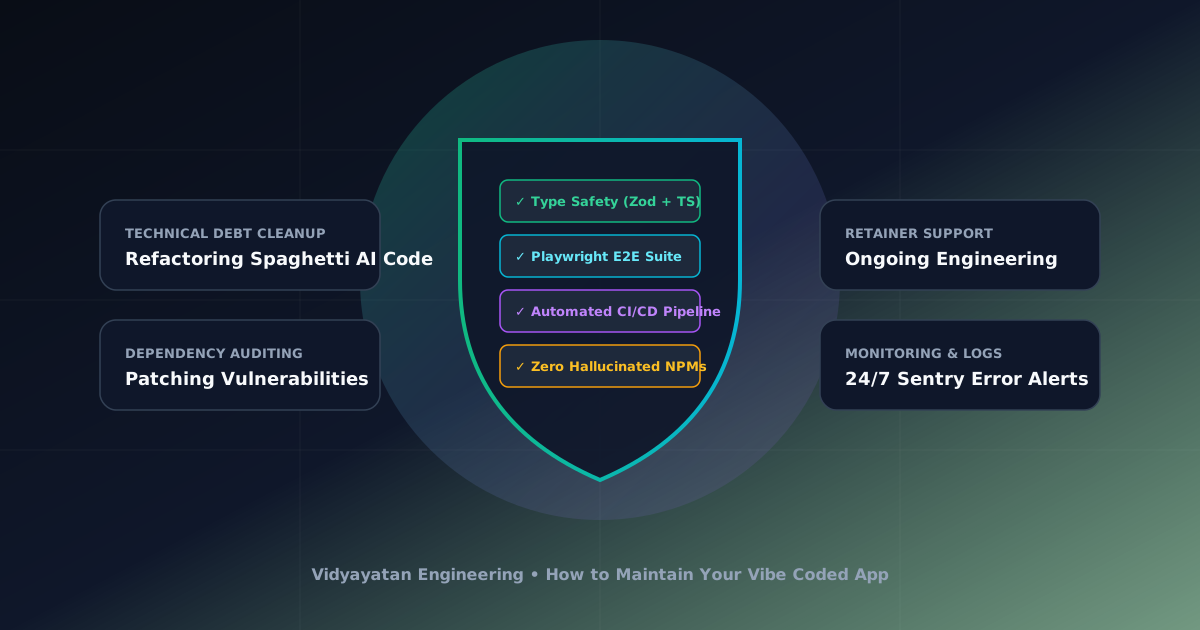
Vidyayatan offers proactive application maintenance retainers tailored for vibe-coded software:
- Proactive Security & Dependency Patches: We keep your frameworks, database drivers, and third-party SDKs up to date and secure.
- Refactoring & Technical Debt Cleanup: Senior engineers systematically refactor messy AI components into clean, maintainable architecture.
- Bug Resolution & Uptime Monitoring: 24/7 error tracking with guaranteed response SLAs.
- On-Demand Feature Engineering: Need a complex integration like Stripe Webhooks, OAuth, or custom LLM pipelines? Our team builds it cleanly and integrates it directly into your codebase.
Keep Your Vibe Coded App Running Smoothly
Don't let tech debt stack up until your application becomes unmaintainable. Partner with engineering experts who know how to keep AI-built applications healthy, fast, and scalable.