
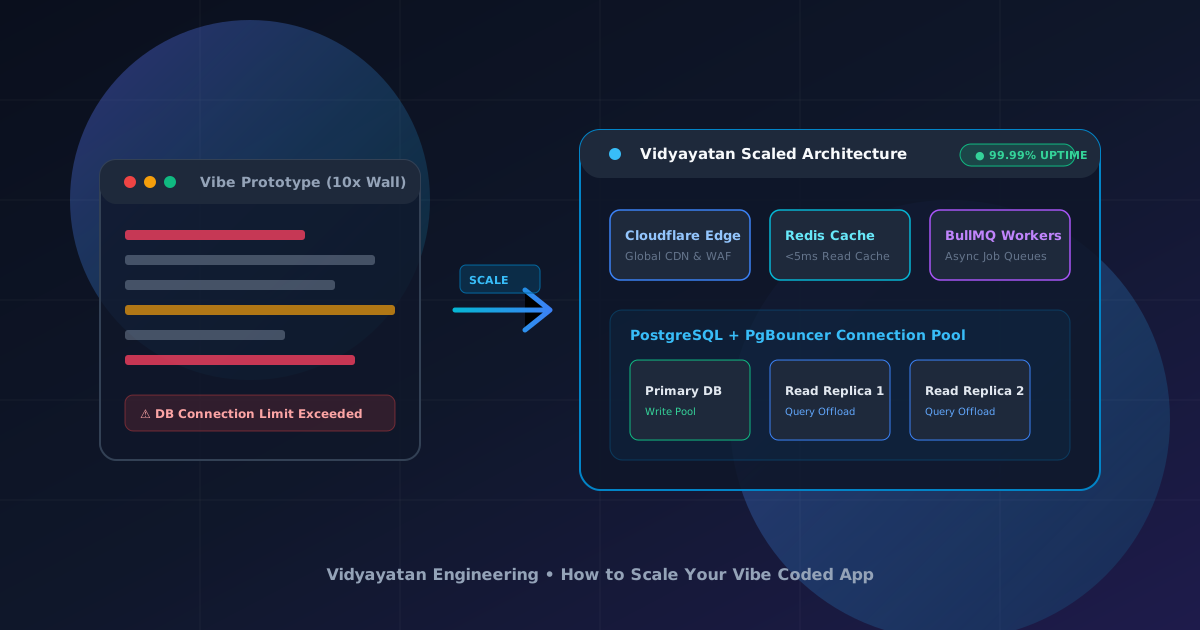
The rise of vibe coding—building entire software applications at lightning speed using AI tools like Cursor, Lovable, Bolt, v0, and Replit Agent—has revolutionized product creation. Founders can go from idea to a functional web or mobile application in days rather than months.
However, once your vibe-coded application hits early market traction, a predictable reality sets in: the vibe coding wall.
What worked for 50 concurrent users starts crumbling under 5,000 users. Database connections get exhausted, client-side state turns into a memory leak, API response times degrade from 200ms to 8 seconds, and adding simple new features starts breaking existing ones.
In this guide, we break down how to scale your vibe-coded app, identify silent architectural bottlenecks, and explain how an experienced engineering partner can take over the heavy lifting while you stay focused on business growth.
Why Vibe-Coded Software Hits a Scale Wall
AI coding assistants are brilliant at writing self-contained UI components, single API endpoints, and basic database CRUD operations. However, LLMs naturally generate code in isolation without understanding holistic system topology.
This leads to several recurring architectural traps in vibe-coded applications:
- Unindexed Database Queries & N+1 Problems: AI code often queries databases using raw ORM filters without indexes, or fetches parent records and loops over them in application memory instead of performing optimized SQL joins.
- Missing Database Connection Pools: Serverless functions spawned by AI-generated Next.js routes continuously open direct database connections, leading to
Too many connectionserrors under peak traffic. - Synchronous Heavy Processing: Long-running operations like PDF generation, image transformations, or external AI API calls are executed inside the HTTP request loop, blocking thread execution and triggering gateway timeouts.
- Monolithic Client & Server State: Massive 1,500-line React components handling fetching, validation, state management, and UI rendering simultaneously.
- No Caching Layer: Every page load or user action hits the primary database directly for static or semi-static data.
5 Practical Steps to Scale Your Vibe-Coded App
1. Hardening the Database Layer
Before adding more servers, optimize how your application communicates with the database:
- Add Database Connection Pooling: Implement connection poolers like PgBouncer or Supabase Vector pooling to reuse existing connections across serverless route invocations.
- Audit & Add Indexes: Run
EXPLAIN ANALYZEon slow queries. Add B-Tree or GIN indexes to frequently queried columns (user_id,created_at,status,tenant_id). - Implement Read Replicas: Route heavy analytical or reporting queries away from the primary database to read replicas.
// Example: Moving from synchronous direct DB query to cached connection pooling
import { db } from "@/lib/db";
import { redis } from "@/lib/redis";

export async function getDashboardStats(organizationId: string) {
  const cacheKey = `stats:${organizationId}`;
  const cached = await redis.get(cacheKey);

  if (cached) return JSON.parse(cached);

  const stats = await db.organization.findUnique({
    where: { id: organizationId },
    select: { activeUsers: true, monthlyRevenue: true, activeSubscriptions: true }
  });

  await redis.set(cacheKey, JSON.stringify(stats), "EX", 300); // 5 min TTL
  return stats;
}
2. Offloading Background Jobs to Async Queues
Never force a user to wait for slow backend operations. Decouple background work using worker queues like BullMQ, Temporal, or AWS SQS:
- Webhooks & Email Notifications
- PDF / Report Generation
- File Upload Processing & Compression
- External LLM / AI API integrations
3. Implementing Edge & In-Memory Caching
Reduce server load by introducing a two-tier caching strategy:
- CDN Edge Caching: Cache static assets, landing pages, and public API responses at the edge via Cloudflare or Vercel.
- Redis In-Memory Cache: Cache database query results, user session objects, and feature flags.
4. Decoupling Monolithic Components into Micro-Services or Clean Modules
Transition your code from a single giant folder into clean, domain-driven modules:
| Monolithic Vibe Code | Scalable Architecture |
|---|---|
1,500-line page.tsx handling DB + UI | Clean UI component + decoupled API route + Service Layer |
| Inline raw SQL in frontend routes | Repository pattern with strict DTO validation |
| Direct client-side third-party API calls | Server-side webhooks & secure gateway proxies |
5. Continuous Telemetry & Observability
You cannot optimize what you cannot measure. Integrate observability early:
- Error Tracking: Sentry or Datadog to capture unhandled client & server exceptions in real time.
- APM & Performance: Highlight slow API endpoints and slow database queries.
Soft Pitch: How Vidyayatan Takes Over and Scales Your Vibe-Coded App
You built your initial product using AI vibe coding, validated your product-market fit, and acquired real users. That's a huge victory. But continuing to rely purely on AI prompts to fix scaling bottlenecks and manage production uptime can become a risky bottleneck.
This is where Vidyayatan steps in. We specialize in taking over vibe-coded and rapidly prototyped applications and transforming them into robust, high-availability software platforms.
How Our Engineering Takeover Works:
- 48-Hour Technical & Security Audit: We inspect your current codebase, database indexes, API bottlenecks, and security vulnerabilities.
- Seamless Architecture Refactoring: We modularize spaghetti code, set up clean domain boundaries, and implement proper caching and queue systems—without pausing your active product development.
- Infrastructure & Auto-Scaling Setup: We configure enterprise-grade CI/CD pipelines, database replication, serverless/Kubernetes auto-scaling, and failover protection.
- Dedicated SLA & Ongoing Engineering: Our senior engineering team manages your infrastructure, monitors uptime, and handles complex feature builds so your team can focus on growth and sales.
Don't let technical debt hold back your growth. Whether you need a full engineering takeover or dedicated backend scaling experts, Vidyayatan ensures your vibe-coded app scales effortlessly to millions of users.
Ready to Scale Your Vibe-Coded App?
If your application is experiencing performance lag, database connection drops, or growing technical debt, let's talk.