
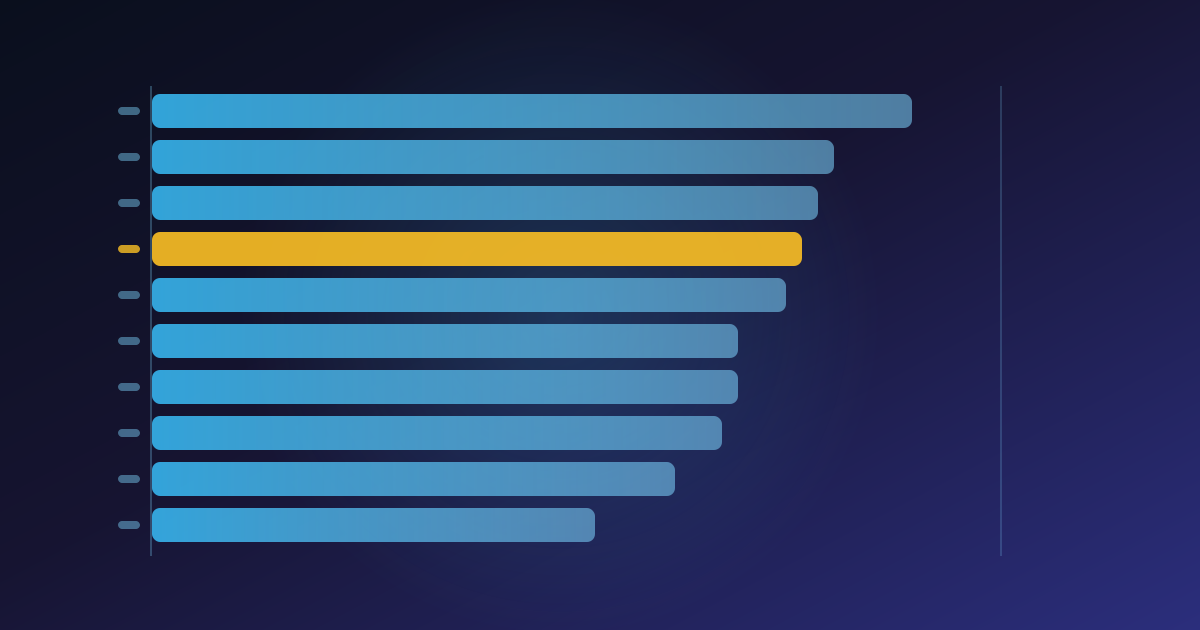
For a business that sells courses in India — not a school, not a college — the decisive axis is not features. It is what the platform takes from every sale and whether you can leave with your customers. On that basis the shortlist is short: LearnWorlds and Thinkific if you sell internationally at flat monthly pricing, Classplus if you are app-first and batch-driven in India, Moodle if you have engineers and want to owe nobody, and Vacademy if you need CRM, fees and a branded app in one system at institute scale.
Below is the working: eight axes, published weights, and where each platform loses.
Disclosure: Vidyayatan builds custom education platforms, and also builds Vacademy, one of the ten scored here. We have scored it on the same rubric as everything else and it does not top the table for this segment — the reasons are in Where Vacademy loses and they are structural, not fixable with a discount.
The method, so you can disagree with it
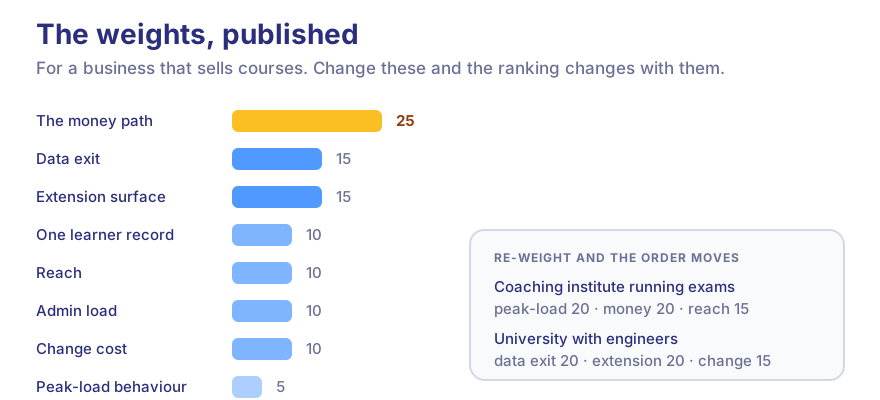
The axes come from the eight we score every LMS on. The weights below are specific to online education companies — businesses whose revenue is course sales. That is a different buyer from a school, and if you are a school this ranking is the wrong one; the weights there put reach and the money path first for entirely different reasons.
| Axis | Weight | Why it carries that weight here |
|---|---|---|
| The money path | 25 | A revenue share is a permanent tax on your business model. Nothing else compounds like it. |
| Data exit | 15 | Your learner list is the asset. A platform that holds it hostage owns your company. |
| Extension surface | 15 | Course businesses live on integrations — payments, email, analytics, affiliates. |
| One learner record | 10 | Marketing, sales and delivery need the same person, or you pay for the reconciliation forever. |
| Reach | 10 | In India this means WhatsApp and a decent app on a mid-range Android. |
| Admin load | 10 | Small teams. Every hour of platform admin is an hour not selling. |
| Change cost | 10 | Pricing, bundles and funnels change constantly in this business. |
| Peak-load behaviour | 5 | Matters only if you run timed assessments. Weight it far higher if you do. |
Scores are 0–3. Where we could not verify a claim from public sources or direct use, the cell says n/v rather than a guess — an incomplete table is more useful than a confident wrong one. Pricing was checked in August 2026 and changes often; treat every figure as a starting point for your own quote.
The table
| # | Platform | Money | Exit | Ext. | Record | Reach | Admin | Change | Peak | Weighted |
|---|---|---|---|---|---|---|---|---|---|---|
| 1 | LearnWorlds | 3 | 2 | 3 | 2 | 2 | 3 | 2 | n/v | 240 |
| 2 | Thinkific | 2 | 2 | 3 | 2 | 2 | 3 | 2 | n/v | 215 |
| 3 | Moodle | 2 | 3 | 3 | 2 | 1 | 1 | 2 | 2 | 210 |
| 4 | Vacademy | 2 | 2 | 2 | 3 | 3 | n/v | 2 | 3 | 205 |
| 5 | Teachable | 2 | 2 | 2 | 2 | 2 | 3 | 2 | n/v | 200 |
| 6 | Graphy | 1 | 2 | 2 | 2 | 3 | 3 | 2 | n/v | 185 |
| 6 | Kajabi | 1 | 2 | 2 | 3 | 2 | 3 | 2 | n/v | 185 |
| 8 | Classplus | 2 | 1 | 1 | 3 | 3 | 3 | 1 | n/v | 180 |
| 9 | Teachmint | 2 | n/v | 1 | 2 | 3 | 3 | 2 | n/v | 165 |
| 10 | Google Classroom | 0 | 2 | 2 | 1 | 2 | 3 | 1 | 2 | 140 |
Out of 300. Unverified axes score zero, which penalises platforms we could not fully check — Vacademy included, on admin load. Read the totals as a sorting aid, not a verdict: the gap between fourth and fifth is 5 points out of 300, which is noise, and the "best for" notes below carry more information than the ordering does.
The ten, briefly
LearnWorlds — Tops this segment on the axis that matters most: zero transaction fees from the Pro Trainer tier upward, at $79–249/month on annual billing. Strong site-building and a genuine integration surface. Weakest on: India-specific reach — no native WhatsApp, and pricing in dollars is a real cost for an India-only business.
Thinkific — $74–149/month annually, 0% platform fee when you bring your own Stripe. The catch is worth knowing: subscriptions and payment plans routed through Thinkific Payments carry about 3.6%, which is precisely the revenue most course businesses want. Weakest on: that asterisk, and the same India-reach gap.
Moodle — No licence fee, no revenue share, and you own the database outright: the best data-exit score on the list by a distance, and a plugin ecosystem nothing here approaches. Weakest on: admin load. Someone competent must own hosting, upgrades and security, and if that person leaves you have a problem. Free software, salaried operator.
Vacademy — CRM and fee collection in the same record as the LMS, WhatsApp built in, branded iOS and Android apps bundled from the 500-learner tier, and a measured concurrency figure for timed exams — the only platform here that publishes one. Best on this list if your business is batch-based teaching at institute scale. It scores 2 rather than 3 on the money path despite taking no share of your sales, because per-learner licensing is the wrong shape for a funnel business. Weakest on: see below.
Classplus — ₹15K–1L a year, app-first, and the strongest account management in the Indian market by most reports. Built for coaching institutes that sell through their own app. Weakest on: it is a closed platform. Extension surface and data exit are the two axes we could verify least, and for a business whose asset is its learner list, that is the risk to price in.
Teachable — A competent, well-understood creator platform with a large user base and predictable behaviour. Weakest on: transaction fees on lower tiers, and nothing India-specific.
Kajabi — The best marketing suite here — funnels, email, landing pages, communities — genuinely one system rather than a stack. If your constraint is marketing rather than teaching, it is a serious answer. Weakest on: no path to zero transaction fees on any plan, on top of entry pricing around $143–199/month. On a 25-weight money axis that is most of the gap.
Graphy — Unacademy-backed, strong India distribution and creator workflow. Weakest on: ₹25K–1L a year plus 5–10% per sale. A revenue share is the most expensive line an education business can sign; at ₹1 crore of course sales, 7% is ₹7 lakh a year, every year, for software.
Teachmint — Freemium, easy to start, good for a solo educator finding out whether the business exists. Weakest on: it thins out at institute scale, and the extension surface is limited.
Google Classroom — Free, familiar, reliable, and scores zero on the money path because it cannot sell anything. For an education company that is disqualifying, which is why it sits last here and would sit far higher in a school ranking.
Where Vacademy loses
Four things, stated plainly, because a ranking from a product's own parent company is worth nothing if it omits them.
The pricing model is wrong for a creator funnel. Vacademy charges per learner per year. That fits an institute where every learner is a paying student. It fits badly where the business model is a large free top-of-funnel converting a small fraction — 20,000 free signups and 800 buyers is a normal, healthy course business, and per-learner pricing charges for all 20,800. Kajabi, Thinkific and LearnWorlds charge a flat monthly fee regardless. If that is your shape, they are cheaper and it is not close.
The integration ecosystem is much smaller. Moodle has two decades of plugins; Thinkific and Kajabi have large app marketplaces. Vacademy has an API and a set of first-party integrations. For a business that wants a specific affiliate tool or a niche email platform, that is a real constraint.
Public API documentation is not openly published. Our own rubric scores this down — we said documentation behind a sales conversation is a warning sign, and the rule applies to us. It caps the extension score at 2.
There is very little independent validation. The established platforms have thousands of third-party reviews accumulated over a decade. Vacademy does not yet, and a buyer is right to weigh that. It is the honest weakness of any younger product and no amount of vendor content substitutes for it.
Change the weights and the order changes
This is the part a ranking usually hides. Re-weight for a coaching institute running timed exams — peak load 20, money path 20, reach 15, extension 5 — and the table reorders substantially: Vacademy and Classplus rise, LearnWorlds and Kajabi fall well down, because international creator platforms are not built for a thousand students sitting a paper on a Tuesday morning.
Re-weight for a university — data exit 20, extension 20, change cost 15 — and Moodle wins outright, as it usually does when the buyer has engineers and a twenty-year horizon.
The ordering is a function of your weights. If a comparison does not publish its weights, it has chosen them for you, and usually in favour of whoever wrote it.
Common questions
Is a revenue share ever acceptable? Early, yes — when you have no sales, a percentage of nothing costs nothing and the platform carries the risk with you. It becomes the worst line in your P&L at the point it succeeds. If you sign one, negotiate a cap or a sunset at a revenue threshold, and get it in writing at signature rather than at renewal.
What is the single most useful thing to do during a trial? Export your data on day one. It takes ten minutes, it tells you more about the vendor relationship than any demo, and the platforms that make it hard are consistent about making other things hard too.
We sell in India but also to NRIs. Does that change the answer? It changes the money path. Check multi-currency support, settlement, and whether the payment stack works for both — this is where India-first and international-first platforms genuinely diverge, and it is worth testing with a real transaction in each currency.
Should we self-host Moodle to save money? Only if you already employ someone who will own it. The licence is free; the operator is not. Budget a competent part-time engineer and Moodle's total cost lands in the same range as a mid-tier SaaS — with far more control and far more responsibility.
How often should we redo this evaluation? Every two years, or when your model changes. Pricing on this list moved materially in the last year in both directions, and a platform that was wrong for you at 500 learners can be right at 5,000.
If you are choosing between two of these and want a second read from someone who builds them, talk to our team. And if you conclude that none of the ten fits, that is worth knowing early — what a custom build actually costs is the other half of this decision.
Pricing and feature claims were checked in August 2026 against the sources linked above and against published vendor pricing. Platforms change terms frequently; verify before signing. Where we could not verify, the table says so.