

A founder and a head of IT can send the same email — "we need a custom platform built" — and mean two jobs that share almost nothing. The code looks similar. Everything around it differs: who decides, what counts as finished, and what the software must talk to on day one.
Here is the plain version, from a custom software development company that builds both.
The one sentence that explains every difference
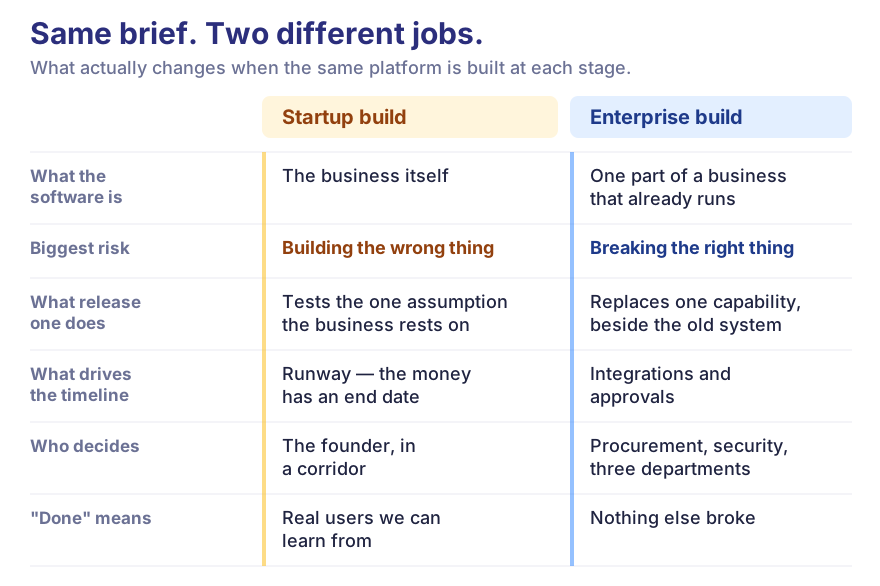
A startup's biggest risk is building the wrong thing. An enterprise's biggest risk is breaking the right thing.
For a startup, the software is the business: nothing to integrate with, no committee, no revenue to protect. For an enterprise, it joins a business that already works. Nobody gets a bonus for a smooth launch — everybody hears when order processing stops for a morning.
Startups: speed, a small scope, and money with an end date
The clock is the constraint. In CB Insights' 2024 study of 431 venture-backed shutdowns, 70% ran out of capital and 43% never found product-market fit. Running out of money is the symptom. Not learning fast enough is the cause.
Release one is not a smaller version of the finished product. It is the cheapest honest test of the assumption the business rests on.
Cut hard: extra user roles, a full admin panel, multiple currencies, microservices. Never cut these — retrofitting costs several times what building costs:
- The data model. Everything else can be rewritten in a week.
- Login and permissions.
- Anything touching money, and its audit trail.
- Backups you have restored from once.
AI tools reach a working demo fast, and that demo helps raise money. It is usually not the thing you scale — see what that code costs six months on and what production grade takes.
The concession: plenty of startups should not build at all. If an off-the-shelf tool covers 80% of what you do, buy it. We have talked clients out of building — that call at HABUILD.
Enterprises: integration, compliance, and the systems already running
Ask an enterprise team what is hard and you rarely hear about features. You hear about the other seven systems.
Integration is the project. The ERP, the identity provider, the warehouse system nobody has patched since 2019. Much of the timeline goes there, and none of it shows in a demo.
Existing debt sets the pace. In McKinsey's survey of 50 CIOs at $1bn-plus companies, tech debt ran to 20–40% of the whole technology estate's value, with 10–20% of the new-product budget going on debt problems instead. A vendor who quotes as though the ground is empty has not looked at it.
Compliance is a hard date. For personal data in India, core DPDP obligations become enforceable on 13 May 2027 — consent, retention, erasure, breach reporting. They touch the data model, so they are a design decision now, not a 2027 patch; we covered the detail for schools and EdTech platforms. Selling to enterprise buyers runs in reverse: expect a security questionnaire, often a SOC 2 report.
Nothing gets replaced in one go. Carve out one capability at a time and move traffic when it is proven.
How we scope each one
HABUILD — the startup end. It ran on Google Sheets and reached 20 lakh users across 36 nations, operating costs down 70%. Scoping meant automating what broke first: payments and member management.
Innowell — the middle. A multi-tenant SaaS mapping tool modelling everything from site down to workstation. That hierarchy was the whole early design decision — get it wrong and you migrate data a year later.
BharatPe — the enterprise end. A payments platform moved from monolith to microservices, now more than 10 billion transactions a year — nothing pausable while it was rebuilt. How that was sequenced.
A startup engagement opens with what must we find out? An enterprise one with what must not break?
Red flags when you evaluate a custom software development company
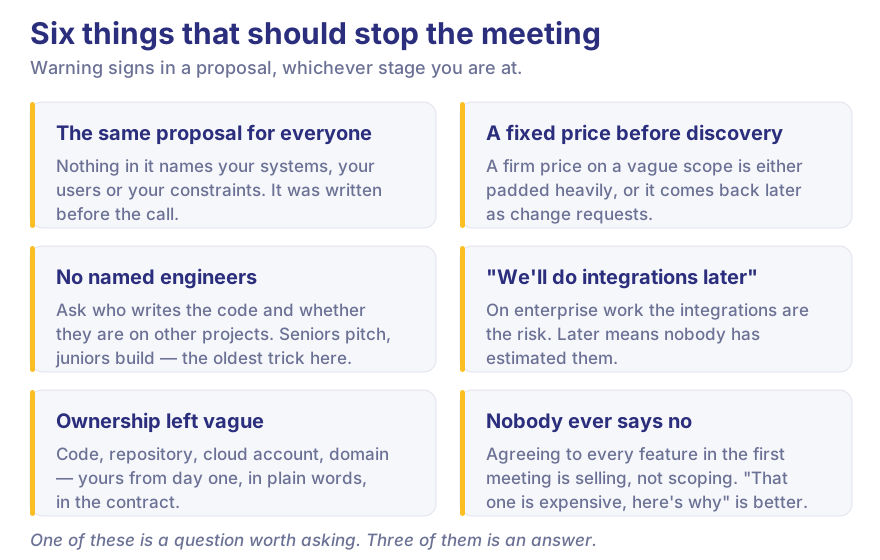
The pattern behind all six: a partner who has not looked at your situation and will not say no. A paid discovery ending in a real estimate beats a fixed price on a vague scope.
The questions to ask before you sign
- Who writes the code, and are they on other projects too?
- What is in release one, and what did you deliberately leave out?
- Who owns the code, repository and cloud accounts on day one?
- How often do you deploy, and what is your change failure rate? DORA's delivery metrics are a fair public standard.
- What happens if we stop in month four? Ask for the handover plan in writing.
Startups: also ask what they would cut if the budget dropped a third. Enterprises: ask which of your existing systems worries them most, and why.
Common questions
What drives the cost difference?
Rarely the features. It is integrations, security review and the number of people who must approve. Two firms can quote the same feature list and land a long way apart.
How long should a first release take?
For a properly scoped startup release one, weeks rather than quarters — if it is not that tight, fix that first. On enterprise work the integration and approval calendar decides the date, not the build.
Should a startup buy off the shelf instead?
Often, yes. Build when your process is genuinely unusual, or when licence costs have overtaken owning the system. Coming off spreadsheets is the common trigger.
Who should own the code?
You, from day one — code, repository, cloud account and domain, in the contract in plain words. Vagueness is the answer.
Can one company do both well?
It can, but ask for a different method, not a different brochure. Then agree the relationship — fixed scope, dedicated team, or longer partnership — and settle the basics with our project kickoff checklist.
Tell us which of the two risks worries you more — talk to us. That one answer changes most of the plan.