
Nobody in a textile business believes the stock report. Not the owner, not the store-keeper who wrote it, not the merchandiser who has to promise a delivery date off the back of it. The real answer lives in the godown, and somebody has to walk there to get it.
That walk is the whole problem. An inventory management system for textile business operations exists to make it unnecessary — to make the number on the screen match the number on the shelf at the moment someone asks. Most of the digital transformation pitch can wait. This cannot. Five signs the manual processes have stopped coping:
Why inventory management matters more in textiles
India's textile sector employs around 45 million people directly and is, in the Ministry of Textiles' own 2025-26 annual report, "MSME driven" — thousands of mid-sized units. Those units carry an inventory problem a hardware store never faces.
One fabric quality arrives in fifteen shades, four widths and two finishes. Each roll has its own length, its own lot, and often a slight colour difference from the roll beside it. Downstream, one style becomes forty SKUs once you multiply size by colour. And the supply chain runs both ways: greige comes in, goes out to a job-worker for dyeing, comes back, gets cut, returns as garments. The count is never static long enough to be counted. Textile industry technology solutions that don't model roll, lot, shade and stage are spreadsheets with a login page.
Sign 1: the stock sheet has more than one owner
It started as one person's spreadsheet. Now it is emailed, forwarded on WhatsApp and edited by dispatch on a phone. Three versions exist. Nobody knows which is current.
That is the textbook manual inventory tracking problem, and the research is blunt. Raymond Panko's review of spreadsheet field audits found the recent, more careful ones turned up errors in at least 86% of spreadsheets examined, with one to two cells in every hundred holding an original mistake — before anyone mistypes a roll length at 7 p.m.
Human error is half of it. The other half is that a spreadsheet has no idea what "now" means. Real-time updates need every issue, receipt and return written down as it happens, by the person doing it, where everyone else reads it. A file on a laptop cannot do that. One client of ours ran on Google Sheets for years; the sheets weren't wrong so much as slowly diverging from the business.
Sign 2: the physical count never matches the book
Every quarter the team counts. Every quarter the count disagrees with the register by a margin nobody can explain, so the register is "adjusted" and the question closes until next time.
This isn't a textile quirk. When DeHoratius and Raman audited close to 370,000 inventory records across 37 stores of one retailer, 65% were wrong — at a well-run company with barcode scanners. A mill tracking rolls by hand should expect worse.
The gap arrives as three bills. Overstocking ties cash up in fabric bought again because the register said it was short. Understocking stops a cutting line while someone drives to the supplier. Dead stock — odd widths, off shades, end-of-lot rolls — accumulates until it is written off. Fashion produced between 2.5 and 5 billion items of excess stock in 2023, by the BoF–McKinsey estimate; some of it began as a mill that didn't know what it already had. Stock management software for the textile industry earns its keep on this sign alone: it closes the gap on every transaction, not once a quarter.
Sign 3: you track fabric by the bale but sell it by the roll
Ask how much of a quality you hold and you get metres. Ask which rolls make up that figure, which lot each came from, and whether the shade will hold across a 600-piece order, and you get a shrug.
This is the sign generic tools miss, and the reason textile inventory management software is its own category. Fabric roll tracking gives every roll an identity: number, length, lot, shade reading, location, history. Batch tracking means that when a dye lot comes back marginally off, you can find every roll from it, every cut ticket that used it, and every garment that needs a second look. Without that, one quality complaint becomes a full-stock inspection. If the system's smallest unit is "metres of quality X", it cannot answer a shade question, whatever the dashboard looks like.
Sign 4: delivery dates are promises, not calculations
A buyer asks when 2,000 pieces can ship. The merchandiser says three weeks, because three weeks is usually right. Two weeks in, someone finds the lining was allocated to another order and never reordered.
Order fulfilment in textiles is a chain of allocations — roll to cut, cut to order, order to ship date — and production planning is only as good as the visibility beneath it. Real-time inventory visibility turns a promised date into a computed one, because the system knows what is free, what is committed and what is on order. The lining shortfall shows up the day the order is entered, not the day the line stops.
Sign 5: purchase, store, production and sales each keep their own truth
Purchase has an order book. The store has a register. Production has a planning board. Sales has whatever it was last told. Each is right about its corner and wrong about the whole, and the owner reconciles them in their head every morning.
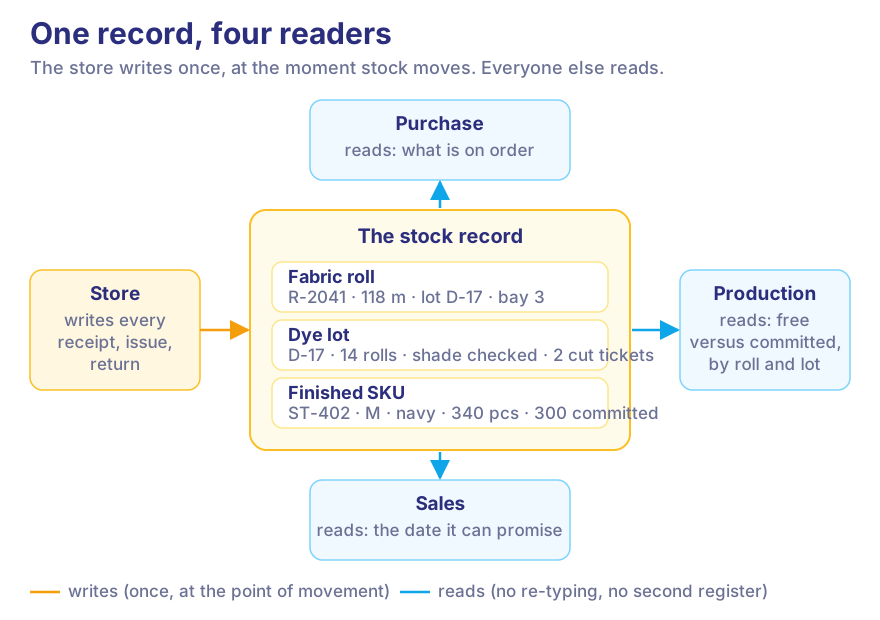
This sign decides the others. Digital inventory management is, at bottom, one record of stock that every team writes to and reads from. The operational dashboards people ask for are a by-product; once the data is in one place, showing it is easy. Stitching disconnected teams' spreadsheets together with formulas produces a handsome report of the wrong numbers.
How Vidyayatan solves this
Vidyayatan Technologies builds this kind of system from the workflow up. We have put purchase orders, inventory, vendors, batch traceability and shipments into one application for manufacturers who had exactly the disconnected-teams problem above, and the fix has the same shape in textiles: model the real unit (roll, lot, stage), record every movement once where it happens, and let everything else read from that.
We already work with apparel and D2C fashion manufacturers, including Krazy Kreators, and a textile engagement follows a pattern. The first weeks are spent in the godown, not a meeting room, because the roll-numbering convention someone invented in 2014 is the data model. Then we build the smallest custom software that replaces the spreadsheet outright — no parallel running, which is just two sources of truth again. An inventory management system for textile business use is judged on one thing: whether the store-keeper trusts it enough to stop keeping the private notebook.
Why choose custom over off-the-shelf textile ERP software
Honest answer first: with one location, a few hundred SKUs and no job-work, a packaged tool is probably right, and we will say so. Custom software is expensive and a commitment; we wrote up where the build-versus-buy line falls for another client, and it applies here.
The case for industry-specific software is that generic textile ERP software makes assumptions — one unit of measure per item, one location per SKU, no notion of a shade lot — and every assumption you don't share becomes a workaround your team runs by hand. Scalability is the other half: a system built on your real unit of stock survives the second factory and the outsourced dyeing without a rewrite. The scoping conversation differs between startups and established manufacturers, but the rule holds: buy what is the same for everyone, build what is your business.
Conclusion
If two or more of these signs describe your Monday, the spreadsheet has already failed; it just hasn't been replaced yet. An inventory management system for textile business operations doesn't make the stock behave. It makes the number honest, which is what every other decision was waiting on.
Talk to Vidyayatan Technologies about what a roll-level system would look like for your unit. If a packaged tool would do, we'll tell you.
FAQ
What does inventory software for a textile business cost?
It depends on what it replaces. A packaged tool for a single-location unit is a monthly subscription. A custom system covering roll tracking, job-work and multi-site stock is a project priced on scope, and we would rather quote after a day on your floor than guess on a call. Compare either against the discrepancy you already carry.
What are the benefits of an inventory management system for textile business operations over a spreadsheet?
One record instead of several, updated when stock moves rather than at day's end. Roll- and lot-level answers to shade and quality questions. Delivery dates computed from committed stock. And a physical count that confirms the book instead of correcting it.
Should a textile business choose custom or off-the-shelf inventory software?
Off-the-shelf if your operation fits its assumptions — one unit of measure, one site, no job-work. Custom once those break, which in textiles usually happens at the roll and lot level. Ask any vendor how they handle a dye lot that comes back off-shade; the answer tells you which side of the line you're on.